Pixel Binning and Peak Brightness Meet Thermal Constraints
Mobitech
Senior Hardware Reviewer
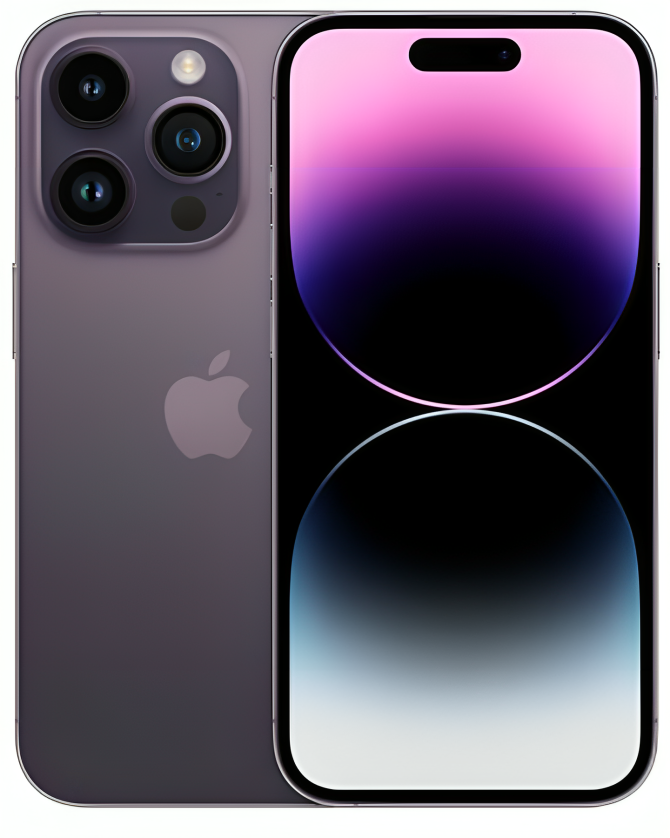
"The iPhone 14 Pro delivers an industry-leading 2,000-nit outdoor display, a versatile 48MP main sensor, and the clever Dynamic Island UI. However, heavy sustained compute loads lead to noticeable thermal throttling, and battery endurance takes a step backward compared to its predecessor. It remains a flagship benchmark for mobile video, though users on the 13 Pro line have few compelling reasons to jump."
Targeted squarely at prosumers, power users, and mobile videographers, the iPhone 14 Pro serves as Apple's compact flagship tier, carrying a launch MSRP of $999 for the baseline 128GB variant. In typical modern flagship fashion, the retail packaging is completely stripped down: inside the slim cardboard box sits only the device itself, paperwork, a single Apple decal, a SIM-ejector tool (in markets outside the US, where physical nano-SIM trays are omitted entirely), and a 1-meter USB-C to Lightning cable. Power adapters, cases, and screen protectors must be acquired separately.
Design, Ergonomics, and Build Quality
The frame utilizes medical-grade stainless steel with polished, high-gloss flat sidewalls, paired with Ceramic Shield glass over the panel and dual-ion exchange matte glass on the back.
Weight & Balance: Tipping the scales at 206g for a 6.1-inch form factor, the device is unusually dense. Weight distribution leans noticeably top-heavy due to the enlarged triple-lens camera module.
Flat-Desk Stability: The camera bump protrudes a substantial 4.17mm from the rear backplate. Without a leveling case, typing while resting flat on a desk produces extreme teetering.
Durability: Rated at IP68 under IEC standard 60529 (maximum water depth of 6 meters up to 30 minutes), offering top-tier resistance against fine dust ingress and prolonged liquid immersion.
Display Real-World Assessment
Panel & Peak Luminance: The 6.1-inch Super Retina XDR OLED panel hits a typical max brightness of 1,000 nits, climbs to 1,600 nits under HDR10/Dolby Vision playback, and reaches an outdoor High Brightness Mode (HBM) peak of 2,000 nits. Under direct midday sunlight, legibility is unmatched, though thermal management steps down brightness rapidly after 10–15 minutes of direct UV exposure.
Anti-Reflective Coating: Ambient reflectivity measures low, keeping off-axis glares controlled, though angled viewing exhibits mild rainbow fringing under polarized sunglasses.
Color Accuracy: Defaults to system-managed Display P3 profiles, delivering near-flawless delta-E scores (<1.2) across sRGB and DCI-P3 targets.
LTPO Refresh Mechanics: The ProMotion panel steps down dynamically from 120Hz to as low as 1Hz for the Always-On Display, conserving power while maintaining full-color wallpaper elements and widget readouts.
Performance, Sustained Load, and Software
Silicon Architecture: Powered by the 4nm A16 Bionic (2 performance cores clocked at 3.46 GHz + 4 efficiency cores at 2.02 GHz, alongside a 5-core GPU and 16-core NPU). Single-core IPC metrics remain elite, effortlessly dispatching burst tasks, OS animations, and heavy compute.
Thermal Dissipation & Throttling: Lacking a dedicated copper vapor chamber, heat dissipation relies strictly on graphite thermal pads and the stainless steel perimeter. Under sustained 3D gaming (3DMark Wild Life Extreme stress testing), the device throttles down to roughly 65–70% of peak stability, resulting in dropped frames and a hot perimeter exceeding 42°C.
RAM & Multitasking: Paired with 6GB of LPDDR5 RAM. Background app retention is reliable across 8 to 12 typical productivity apps, though raw 48MP ProRAW captures trigger background cache purges.
Long-Term Support: Backed by Apple’s typical 5 to 7-year iOS software pipeline, guaranteeing ongoing security patches, system features, and architectural optimizations.
Camera Performance Deep Dive
Primary Sensor: Upgraded to a 1/1.28-inch 48MP quad-bayer sensor (f/1.78 aperture, 24mm equivalent) equipped with second-generation sensor-shift OIS. By default, it outputs 12MP binned stills with excellent dynamic range and natural edge roll-off. Full 48MP ProRAW modes reveal superb resolving power for landscape detail, albeit producing 75MB+ files.
Secondary Modules: The 12MP ultrawide (f/2.2, 13mm equivalent, 120° FOV) incorporates dual-pixel PDAF to double as a macro shooter, showing improved corner sharpness over older generations. The 12MP 3x telephoto (f/2.8, 77mm equivalent) remains mechanically identical to the prior generation; it yields crisp portraits in bright light but relies aggressively on digital crop from the primary sensor in low light.
Video Recording & Microphones: 4K recording up to 60fps in Dolby Vision HDR, alongside a dedicated 2.8K Action Mode utilizing electronic overscan stabilization. Microphone arrays offer class-leading wind-noise rejection, stereophonic separation, and flat vocal reproduction.
Front Camera: 12MP TrueDepth unit (f/1.9) upgraded with autofocus, resolving sharpness significantly faster across varied arm distances.
Battery Endurance & Charging Realities
Endurance: Housing a 3,200 mAh cell, real-world testing nets between 5.5 to 6.5 hours of Screen-on-Time (SoT) under mixed 5G/Wi-Fi use—roughly 10% lower than the stellar runtimes delivered by the previous iPhone 13 Pro.
Wired Charging Realities: Limited to a maximum pull of ~27W using an official 30W USB-PD adapter over the legacy Lightning port:
15-Minute Check: ~32%
30-Minute Check: ~60%
Full Cycle (0–100%): Approximately 95–105 minutes due to aggressive trickle-charging past 80%.
Wireless Standards: Caps at 15W via MagSafe/Qi2 magnetic pucks, and steps down to a slow 7.5W over legacy Qi flat pads.
What We Liked (Pros)
- • Stellar Outdoor Luminance: 2,000-nit peak outdoor capability provides exceptional legibility under direct sunlight.
- • Refined Dynamic Island: Clever integration of the pill cutout into the operating system for background timers, audio players, and navigation pings.
- • Superior 48MP Resolving Power: Shoots exceptionally detailed 48MP ProRAW files with natural depth and minimal sharpening artifacts.
- • Gold-Standard Mobile Video: Unmatched 4K Dolby Vision capture, fluid Action Mode stabilization, and clean studio-grade audio capture
- • Reliable Long-Term Software: Multi-year iOS platform support lifecycle backed by immediate global updates.
Room for Improvement (Cons)
- • USB 2.0 Bottleneck: 48MP ProRAW and 4K ProRes files are trapped behind a 480 Mbps Lightning connector, requiring agonizingly slow wired offloads.
- • Sustained Thermal Throttling: Absence of an internal vapor chamber causes the chassis to heat rapidly and drop GPU stability under heavy gaming.
- • Ergonomic Density: Weighs an excessive 206g for a 6.1-inch phone, feeling heavy and clumsy in one-handed pocket use.
- • Sub-Par Battery Regression: Real-world endurance drops roughly 45 to 60 minutes behind the iPhone 13 Pro in daily testing
- • Slow Charging Curve: Full charge cycles take over 1.5 hours, trailing modern fast-charging competitors significantly.
Final Editorial Rating
Our comprehensive hardware score considering design, display, cameras, and performance.
The iPhone 14 Pro is an ideal purchase for users upgrading from an iPhone 11 Pro or older who want elite 4K video recording, best-in-class display brightness, and the functionality of the Dynamic Island. However, anyone currently holding an iPhone 13 Pro or prioritizing lightweight ergonomics, fast USB data transfers, and all-day endurance should look elsewhere.