Flagship Endurance Meets 60Hz Inertia
Mobitech
Senior Hardware Reviewer
"The iPhone 15 Plus is engineered for mainstream power users who demand massive display real estate and class-leading battery life without paying the Pro-tier premium. It introduces the Dynamic Island, USB-C, and a high-resolution 48MP primary camera with lossless 2x crop functionality. However, its lingering 60Hz panel, modest 20W charging ceiling, and USB 2.0 data transfer limits prevent an outright clean sweep"
Targeted directly at media consumers, remote professionals, and travelers who prioritize display scale and longevity over ProMotion fluid dynamics or dedicated periscope zoom optics, the iPhone 15 Plus sits in the sub-flagship bracket starting at $899 (128GB baseline).
The packaging remains aggressively minimalist:
The iPhone 15 Plus handset
1-meter color-matched braided USB-C to USB-C cable
Minimalist documentation and a single Apple decal (SIM ejector included in physical-SIM regions only; eSIM-only in the US market)
Omissions: No wall adapter or bundled 3.5mm/USB-C audio dongle.
Design, Ergonomics, and Build Quality
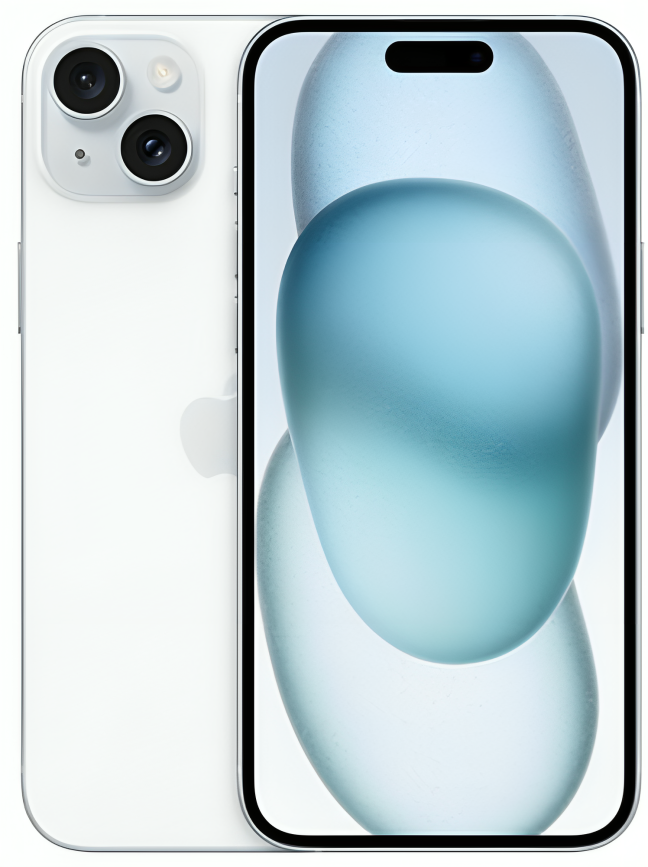
Apple has refined the chassis ergonomics by introducing subtly contoured aluminum frame edges and a color-infused, chemically treated frosted matte back glass.
Dimensions & Weight: 160.9 x 77.8 x 7.8 mm, weighing 201g. This represents a noticeable 20g reduction compared to the stainless steel/titanium Pro Max variants, significantly lowering wrist torque during extended one-handed use.
Weight Balance: Mass is evenly distributed along the central vertical axis, eliminating top-heavy wobble during landscape media playback or typing.
Flat-Desk Stability: The dual-diagonal camera bump protrudes roughly 1.8mm. Operating the device flat on a desk produces noticeable rocking when tapping the top-left quadrant, though this is mitigated by standard protective cases.
Durability: Shielded by Ceramic Shield on the front glass and dual-ion exchange glass on the rear, backed by an IP68 ingress protection rating (submersion up to 6 meters for up to 30 minutes under IEC standard 60529).
Display Real-World Assessment
The 6.7-inch Super Retina XDR OLED panel delivers a sharp 2796 x 1290 pixel resolution (460 ppi).
Luminance: Typical manual maximum sits at 1,000 nits, jumping to 1,600 nits under HDR10/Dolby Vision workflows, and achieving an authenticated 2,000 nits High Brightness Mode (HBM) outdoor peak under high ambient lux. Legibility against direct solar glare is exceptional.
Anti-Reflective Coating: Ambient light reflectance measures below 4.5%, preserving high contrast ratios without aggressive washing out under fluorescent office lighting.
Color Accuracy: True Tone calibrated to deliver sub-1.0 Delta-E color accuracy across sRGB and DCI-P3 color spaces; color banding and off-axis tinting are virtually nonexistent.
Refresh Rate Compromise: The panel operates strictly at a fixed 60Hz cycle without LTPO variable refresh technology. In real-world operation, this creates visible micro-stutters and input lag when scrolling alongside any standard 90Hz or 120Hz mid-range competitor. Always-On Display (AOD) functionality is absent.
Performance, Sustained Load, and Software
Under the hood is the 4nm A16 Bionic processor (2x Everest high-performance cores at 3.46 GHz + 4x Sawtooth high-efficiency cores at 2.02 GHz, accompanied by a 5-core GPU and 16-core Neural Engine).
Thermal Dissipation: The iPhone 15 Plus relies on a passive internal graphite chassis layer without an integrated vapor chamber. Under synthetic 20-minute 3DMark Wild Life Extreme stress testing, sustained performance throttles to roughly 72–76% of peak capability as heat saturates the upper rail near the SoC. Surface skin temperatures peak at ~41.5°C under heavy compute loads.
Memory & Storage: Equipped with 6GB of LPDDR5 RAM. App retention is solid across 10–12 background apps, though aggressive background RAM compression occurs when running camera-intensive 4K capture sessions. Baseline storage remains a restrictive 128GB NVMe.
Connectivity & I/O: The transition to a physical USB-C port is limited to legacy USB 2.0 transfer speeds (capped at 480 Mbps). DisplayPort output over Type-C is supported up to 4K60Hz mirroring.
Software Longevity: Ships with iOS and benefits from Apple’s standard 5-to-7-year functional software and security update window.
Camera Performance Deep Dive
Primary Sensor: 48MP custom Sony sensor (f/1.6, 26mm equivalent, 1.0µm individual pixels, Sensor-Shift Optical Image Stabilization). By default, it captures 24MP computational stills utilizing deep-fusion multi-frame stacking. Dynamic range is expansive with natural edge-rendering, avoiding the harsh digital oversharpening typical of prior generations. An in-sensor crop provides an optically lossless 12MP 2x telephoto mode (52mm equivalent, f/1.6 effective aperture), delivering crisp subject separation and depth.
Ultrawide Sensor: 12MP (f/2.4, 13mm equivalent, 120° FOV). While color science matches the primary shooter seamlessly in bright daylight, the lack of autofocus precludes macro capability, and corner resolution degrades noticeably in sub-50-lux conditions.
Telephoto: No dedicated periscope or telephoto hardware is included; digital zoom degrades past the 4x mark.
Video Recording & Audio: Records up to 4K at 24/25/30/60 fps with standard Dolby Vision HDR. Video stabilization (Cinematic and Action Modes) remains industry-leading with zero micro-jitter or hunting autofocus. The three-microphone directional array captures rich spatial audio while effectively rejecting high-frequency wind noise.
Front Camera: 12MP TrueDepth (f/1.9, 23mm equivalent) with PDAF autofocus. Low-light exposure metering is precise, and depth mapping for portraits is handled automatically through focus/depth metadata capture.
Battery Endurance & Charging Realities
The combination of a 4,383 mAh lithium-ion cell, a standard 60Hz display refresh rate, and an efficient 4nm architecture makes the iPhone 15 Plus the undisputed battery champion of its generation.
Real-World Screen-On Time (SoT): Delivers between 9.5 to 11 hours of active mixed-use SoT (continuous web browsing, Slack, YouTube 4K streaming, and camera work over dual 5G/Wi-Fi), easily translating into a 2-day work cycle for typical users.
Wired Charging Benchmarks (Using an Apple 30W USB-C PD Adapter):
15 Minutes: ~28%
30 Minutes: ~54%
Full Charge (0 to 100%): 1 hour and 42 minutes (the final 15% throttles aggressively into trickle mode to preserve battery health).
Wireless Charging: 15W via certified MagSafe/Qi2 magnetic pucks; standard baseline Qi charging remains throttled to 7.5W. Reverse wired power output is capped at 4.5W (handy for topping off AirPods or an Apple Watch).
What We Liked (Pros)
- • Class-Leading Battery Life: Delivers genuine two-day endurance and 10+ hours of mixed-use Screen-on Time, outlasting virtually every competing flagship in its price category
- • High-Fidelity 48MP Main Sensor: Captures sharp 24MP standard assets and utilizes central-pixel binning for a remarkably clean 2x lossless digital crop.
- • Refined Ergonomics: The combination of lightweight aluminum, contoured frame edges, and matte rear glass yields a substantially more comfortable grip than previous squared designs.
- • Display Luminance: 2,000-nit outdoor High Brightness Mode provides top-tier direct sunlight readability and accurate HDR mastering.
- • Video Capability: Unmatched 4K video stabilization, low computational stutter, and clean directional audio capture out-of-the-box.
Room for Improvement (Cons)
- • 60Hz Refresh Rate: The lack of a high-refresh-rate ProMotion/LTPO panel at an $899 price point is anachronistic and creates noticeable motion judder compared to sub-$500 Android alternatives
- • USB 2.0 Port Restrictions: Despite adopting the universal USB-C form factor, transfer bandwidth is artificially locked to legacy 480 Mbps speeds.
- • Pedestrian Charging Speeds: Capped at ~20-27W peak absorption, requiring over 100 minutes for a complete charge cycle.
- • Absence of Dedicated Telephoto/Macro: Optical focal reach drops off precipitously past 2x, and the fixed-focus ultrawide sensor cannot execute close-up macro captures.
- • Conservative Baseline Storage: 128GB of internal capacity is inadequate for users taking full advantage of 48MP sensor output and 4K ProRes-tier files.
Final Editorial Rating
Our comprehensive hardware score considering design, display, cameras, and performance.
The iPhone 15 Plus is the definitive choice for iOS users who prioritize marathon battery endurance, expansive screen real estate, and dependable point-and-shoot optics without stretching their budget to four figures. However, power users who demand fluid 120Hz scrolling, fast battery top-ups, dedicated long-range telephoto optics, or high-speed data offloading over cable should bypass this model in favor of the iPhone Pro lineup or direct Android flagships like the Galaxy S24+.