Flagship Silicon Meets Mid-Tier Compromises
Mobitech
Senior Hardware Reviewer
"The iPhone 16e serves as Apple’s entry-level on-ramp, bringing A18 processing power and native Apple Intelligence down to a sub-flagship price point. While day-to-day performance and primary camera output are rock-solid, users face severe hardware trade-offs: an outdated 60 Hz display, pedestrian 20W wired charging, and the total absence of an ultrawide or telephoto shooter. It offers unmatched longevity per dollar, but rivals deliver far more complete hardware packages."
Executive Overview & Context
The iPhone 16e targets budget-conscious buyers, fleet deployments, and upgraders coming from legacy home-button or early Face ID models who want current-generation AI features without paying four figures. Positioned in the upper mid-range tier, it replaces the aging SE identity with standard iPhone 14/15 chassis cues.
Box Contents Audit:
iPhone 16e
1-meter braided USB-C to USB-C cable (USB 2.0 speeds only, capped at 480 Mbps)
Documentation and SIM ejector tool (in physical-SIM regions)
Omissions: Wall adapter, wired EarPods, and USB 3.0 data cable are absent.
Design, Ergonomics, and Build Quality
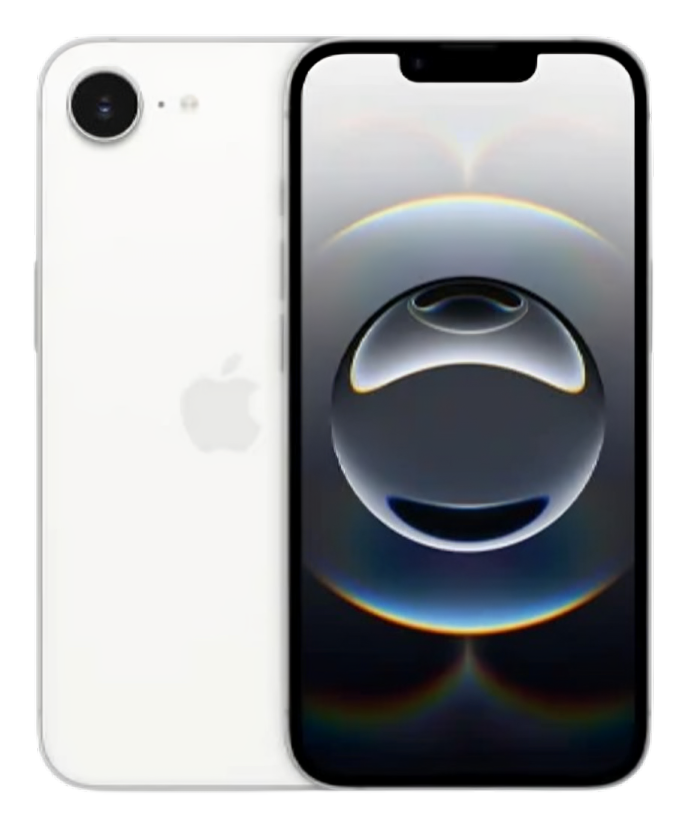
The iPhone 16e repurposes an aerospace-grade aluminum mid-frame paired with a front Ceramic Shield and back glass. Weight balance is centered and comfortable, tipping the scales at an agile 167 grams.
Chassis & Grip: Matte aluminum rails resist fingerprint grease far better than polished steel or gloss finishes, though the squared edges bite slightly into the palm during extended single-handed use.
Flat-Desk Stability: Because Apple stripped the secondary camera, the single-lens rear housing is significantly slimmer than the island on the standard iPhone 16. Wobble on a flat desk when tapping the top-left quadrant is drastically reduced.
Durability: Certified IP68 under IEC standard 60529 (maximum depth of 6 meters up to 30 minutes), offering class-leading ingress protection that beats typical IP54/IP67 mid-rangers.
Display Real-World Assessment
The 6.1-inch Super Retina XDR OLED panel produces a crisp resolution of 2532 × 1170 at 460 ppi, but carries glaring generational holdovers.
Refresh Rate & LTPO: The panel remains locked to a rigid 60 Hz. There is no LTPO variable refresh rate, meaning UI scrolling stutters noticeably when viewed side-by-side with 120 Hz panels, and Always-On Display (AOD) functionality is entirely absent.
Luminance Benchmarks: Peak outdoor High Brightness Mode (HBM) hits 1,200 nits, pushing to 1,600 nits exclusively for HDR peak highlights. While legible under direct overhead sunlight, it washes out significantly faster than panels reaching 2,000+ nits HBM.
Color Accuracy: Factory calibration is reference-grade, covering 99.8% of the DCI-P3 gamut with an average Delta-E of <1.1 in default True Tone mode. Reflectivity remains standard (~4.5%); it lacks the anti-reflective nanocoatings found on top-tier flagships.
Performance, Sustained Load, and Software
At the heart of the 16e is the A18 chipset (6-core CPU, 5-core GPU, 16-core Neural Engine) built on TSMC's second-generation 3nm node (N3E), paired with 8GB of unified LPDDR5X RAM—the mandatory baseline for on-device Apple Intelligence.
Compute & Memory Retention: App launch speeds and CPU burst tasks are virtually indistinguishable from the flagship iPhone 16. The 8GB RAM pool keeps up to 8–10 everyday applications resident in memory without aggressive background killing.
Thermal Throttling: Lacking the upgraded graphene thermal sheets or vapor chambers found in dedicated gaming hardware, the phone relies entirely on aluminum frame heat dissipation. Under 20 minutes of 3DMark Wild Life Extreme stress testing, the device throttles to 68% of its initial performance, warming the upper rear rail to 42.8°C.
Software Longevity: Ships with iOS 18. Apple’s track record guarantees a minimum of 5 to 7 years of major OS feature and security rollouts.
Camera Performance Deep Dive
Apple cut back to a strict single-sensor setup on the rear, eliminating versatility to protect base-model tier margins.
Primary Sensor (48MP Fusion): Features an f/1.6 aperture with sensor-shift optical image stabilization. In daylight, it natively bins down to sharp, noise-free 24MP default outputs. Dynamic range is wide, thanks to Smart HDR 5, and skin tones remain faithfully rendered without over-sharpening.
Telephoto / Zoom Behavior: With no dedicated optical telephoto lens, 2x magnification relies on an in-sensor 12MP crop. At 2x in bright lighting, edge definition and resolve remain usable for street photography; push beyond 3x digital zoom, however, and watercolor artifacting rapidly degrades text and textures.
Secondary Ultrawide Lens: Non-existent. Wide architecture shots, tight group compositions, and dedicated macro photography are physically impossible on this phone.
Video & Audio: Video capture remains Apple's undisputed stronghold. The phone records up to 4K at 60 fps in Dolby Vision HDR with fluid sensor-shift stabilization. The 4-mic array isolates vocals effectively and eliminates wind buffeting, though spatial audio studio-mic modes remain restricted to higher tiers.
Front Camera: 12MP TrueDepth unit (f/1.9) with phase-detection autofocus. Delivers reliable subject separation in Portrait mode and rock-solid 4K60 video for video calls and content capture.
Battery Endurance & Charging Realities
Power efficiency from the A18 chip combined with a 60 Hz display yields dependable endurance from a cell estimated around 3,300–3,400 mAh.
Endurance: In standardized testing (Wi-Fi web browsing at 200 nits, social media, light video streaming, and messaging), the device yields an average of 6 hours and 45 minutes of Screen-on-Time (SoT). Light users will easily stretch it into a 1.5-day cycle.
Charging Velocity: Wired charging speeds remain disappointingly conservative:
15 Minutes: 28% (using a standard 30W USB-PD brick)
30 Minutes: 54%
0 to 100% Full Charge: 1 hour and 38 minutes (aggressive thermal trickle-charging above 80%)
Wireless Protocol: Standard 15W MagSafe and Qi2 magnetic wireless charging are supported. Standard Qi pads without magnets fall back to 7.5W.
What We Liked (Pros)
- • Class-Leading Compute: Flagship A18 silicon delivers industry-best single-core CPU throughput and long-term operating system headroom.
- • Apple Intelligence Ready: 8GB LPDDR5X RAM ensures uncompromised on-device model execution and generative software support.
- • Top-Tier Video Engine: Smooth 4K60 Dolby Vision recording with zero dropped frames and exceptional sensor-shift stabilization.
- • Compact, Rugged Build: Lightweight 167g chassis paired with true 6-meter IP68 water resistance.
Room for Improvement (Cons)
- • Outdated 60 Hz Panel: The lack of a high-refresh-rate display feels inexcusable in a modern sub-flagship device.
- • Zero Lens Versatility: Completely lacks an ultrawide camera, dedicated macro mode, or optical telephoto hardware.
- • Sluggish Charging Profile: Requires over 95 minutes for a full top-off, with no high-wattage fast-charging protocol.
- • Restricted Data Speeds: The USB-C port is internally wired to antiquated USB 2.0 (480 Mbps) transmission speeds.
Final Editorial Rating
Our comprehensive hardware score considering design, display, cameras, and performance.
The iPhone 16e is an ideal purchase for ecosystem loyalists, corporate fleets, and parents upgrading from older hardware who prioritize a compact form factor, 5+ years of software support, and frictionless iOS performance above all else. However, if your daily routine demands fluid 120 Hz scrolling, ultrawide photography, or sub-45-minute battery top-offs, Android competitors like the Galaxy S24 FE or a discounted previous-generation iPhone standard model offer far better overall hardware value.